
Berwick Street Market
A delayed-action bomb left a large crater at the lower end of Berwick Street Market. Contemporary reporting recorded traders returning to business around the crater.
Original West End at War page still soughtThe museum of Soho · Digital archive
Soho, the Blitz and the recovery of a lost community history archive
Between 1940 and 1945 the West End was repeatedly attacked from the air. Soho's streets, homes, churches, theatres, clubs and businesses were damaged — while residents, wardens, firefighters and volunteers kept the district functioning.
A LOST ARCHIVE, RECOVERED
West End at War was created by Westminster City Archives with volunteers and community participants. For five years volunteers researched Second World War bomb incidents, linked them to a detailed bomb map, and scanned primary documents from Westminster's Civil Defence archive.
The original website brought together bomb-incident summaries, eyewitness testimony, maps, photographs, Civil Defence documents, contemporary artworks and rare colour film. The site later disappeared from the web.
The Museum of Soho was subsequently given an incomplete collection of project files. This digital archive brings surviving material back together, concentrating on Soho while retaining important connected stories such as the Café de Paris and Al Bowlly.
READING THE BLITZ
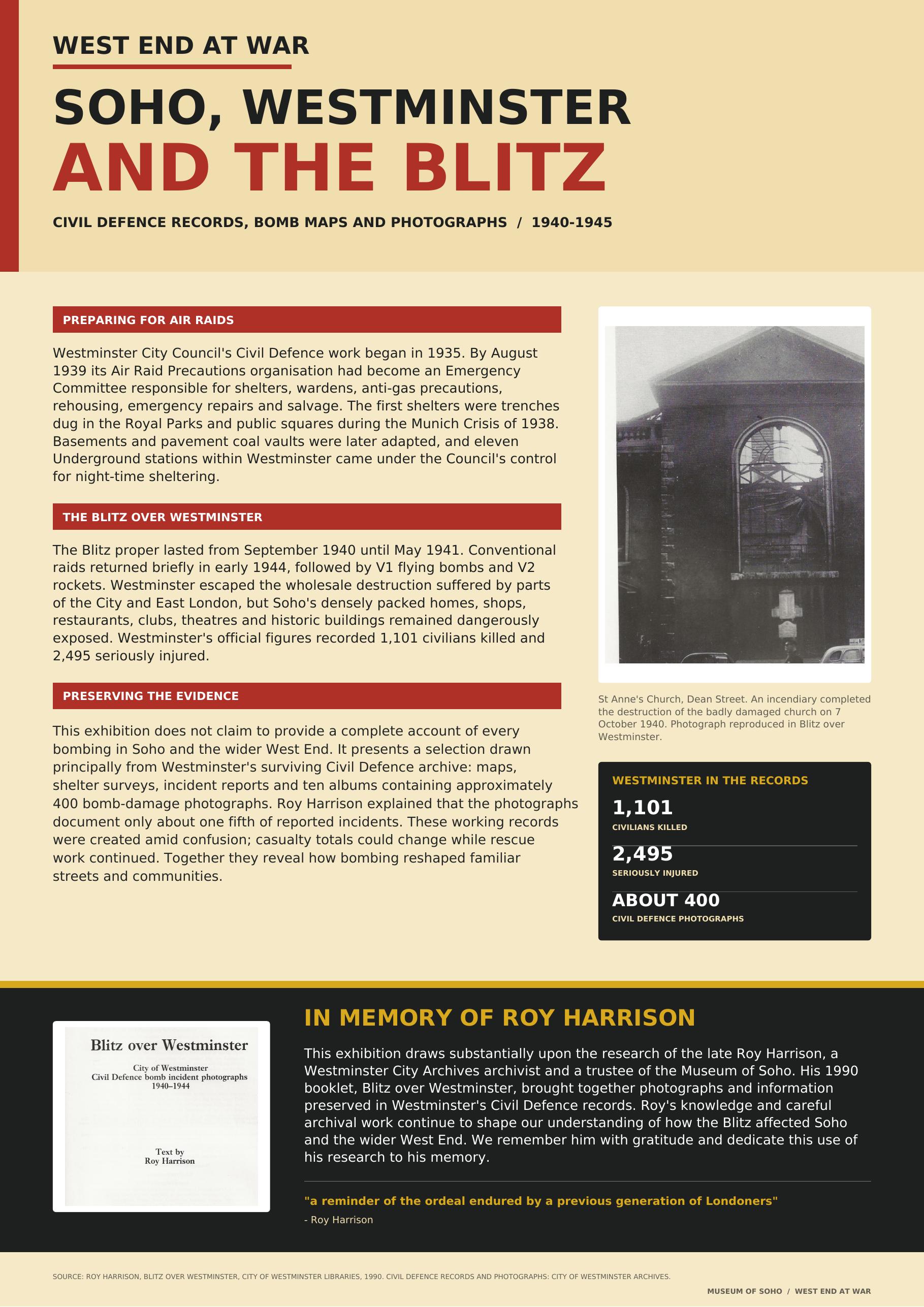
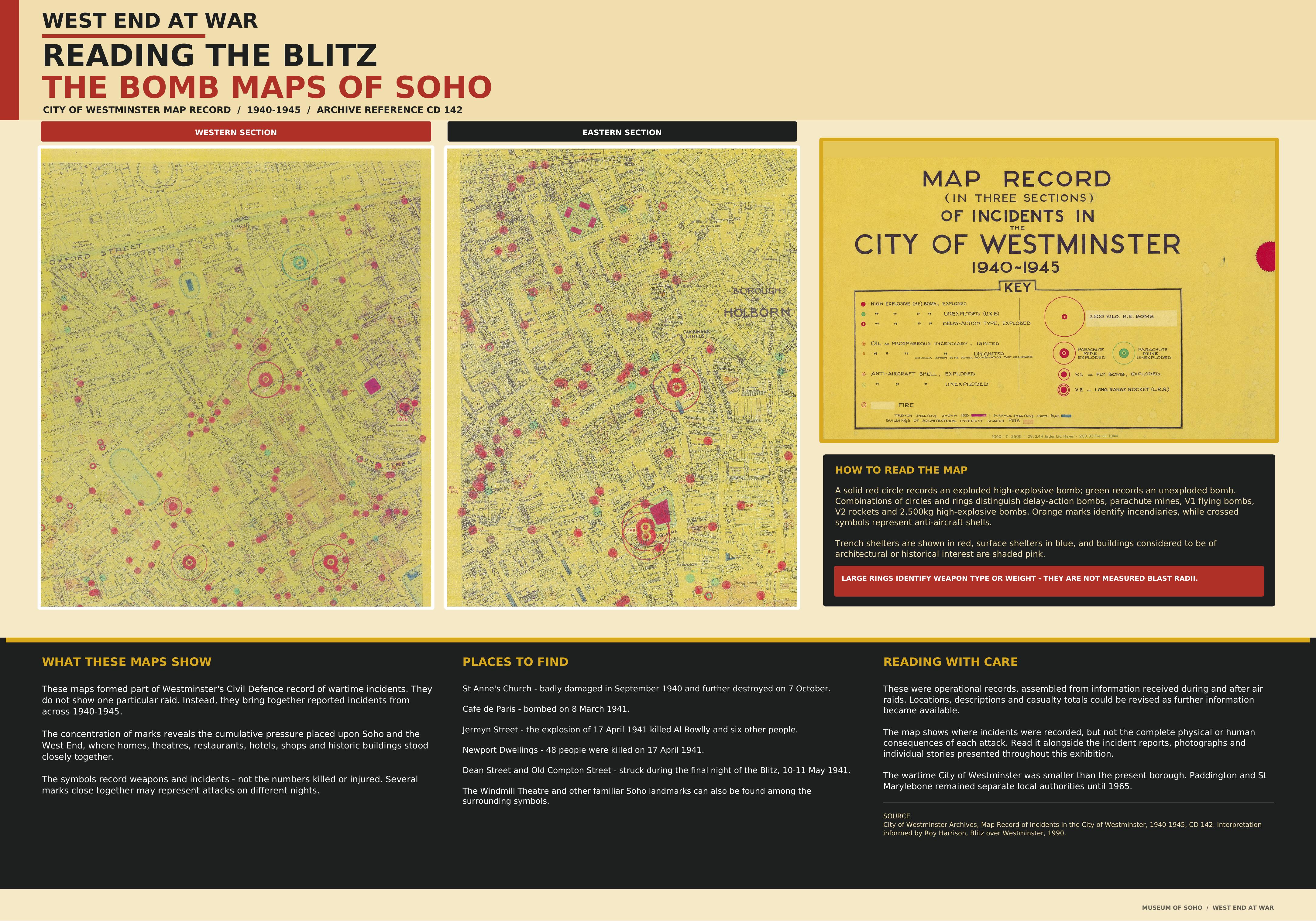
Westminster’s Map Record of Incidents in the City of Westminster, 1940–1945 (archive reference CD 142) brings together reported wartime incidents across the period. Red and green symbols distinguish exploded and unexploded bombs; other rings and symbols record delay-action bombs, parachute mines, V1s, V2s, incendiaries and anti-aircraft shells. The large rings identify weapon type or weight rather than measured blast radius.
SOHO 1940–45
This chronology combines recovered West End at War references with Museum of Soho research. Where the original website file has not survived, the reconstruction is identified in the archive catalogue rather than passed off as an original.
A delayed-action bomb left a large crater at the lower end of Berwick Street Market. Contemporary reporting recorded traders returning to business around the crater.
Original West End at War page still soughtSt Anne's, the historic parish church of Soho, was devastated during the Blitz. The ruined tower and surrounding damage became one of the defining wartime images of the neighbourhood.
Add Museum photographs + Leo Zanelli testimonyThe fire station on Shaftesbury Avenue was virtually demolished. Firefighters and civilians were killed and appliances buried in the wreckage.
West End at War damage photograph referenced; original asset soughtA bomb struck the celebrated underground nightclub during a performance. Bandleader Ken “Snakehips” Johnson was among those killed. Two separate West End at War articles about the incident are known to have existed.
See dedicated story belowDean Street and surrounding streets were caught in one of the most destructive raids of the Blitz. Surviving accounts include Graham Greene and Dorothy Glover leaving the Hungarian Csarda while Glover was fire-watching.
Further original incident files soughtThe singer Al Bowlly was killed at his home in Duke's Court during the raid of 16–17 April. His death has become one of the best-known individual stories of the Blitz in the West End.
See dedicated story belowA high-explosive bomb struck buildings on Dean Street. A surviving reference identifies a sequence of photographs on the original West End at War page, including one in which Denny's clock could be seen.
Original photographic sequence soughtPRIMARY SOURCES
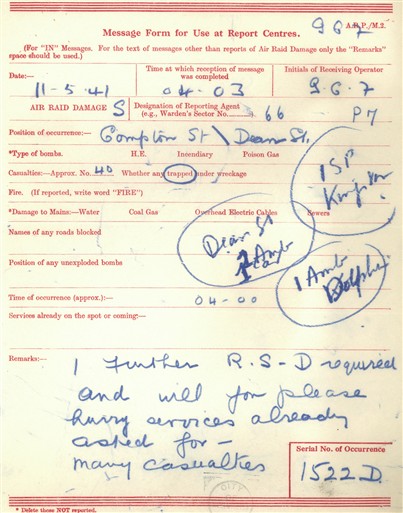
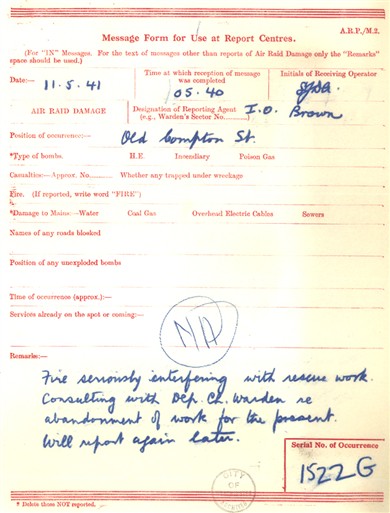
The recovered Soho dossier now gives us surviving message forms and damage reports for Old Compton Street and Dean Street, St Anne’s Church, 24 Greek Street, Carlisle Street, Brewer Street, Soho Fire Station and the Jermyn Street incident in which Al Bowlly died. These are operational records, often written while rescue work was still under way, so uncertain readings remain identified as such.
AN AFRICAN AIR-RAID WARDEN
Ita Ekpenyon, a Nigerian teacher and actor living in London, served as an Air Raid Precautions warden in St Marylebone. His wartime account, Some Experiences of an African Air-Raid Warden, became the basis of one of West End at War's most important educational projects.
The surviving project combines Ekpenyon's own words with rare colour film shot by A. E. Reneson Coucher, still photographs from Winifred Ekpenyon and Westminster Archives, and animation made by children and parents working with Westminster Archives and animator Tom Hillenbrand.
Ekpenyon's service card, photographs, the St Marylebone bomb map and ARP learning material also survive in the recovered publication.
8 MARCH 1941
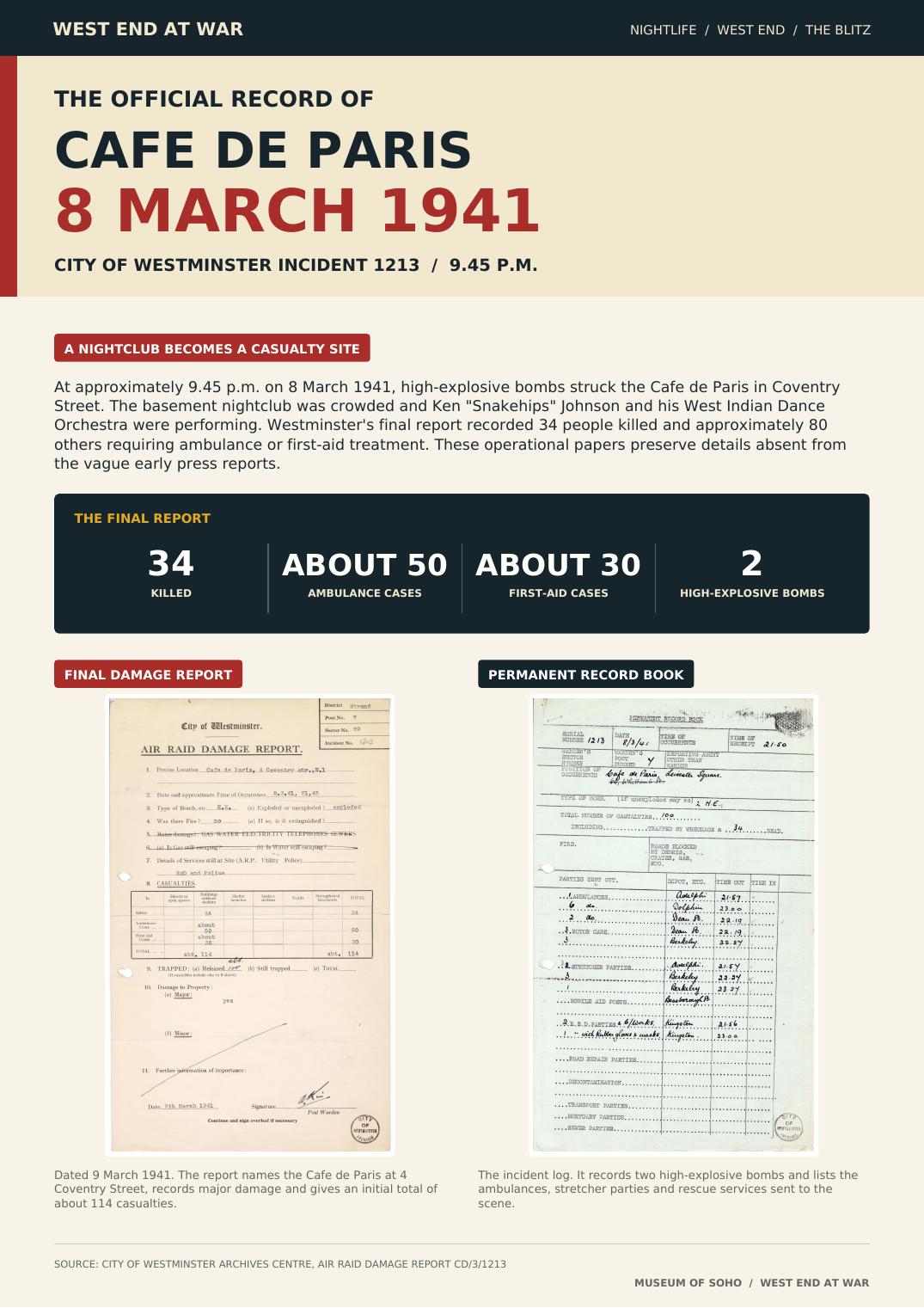
The Museum can now show the surviving official record alongside the story of Ken “Snakehips” Johnson. Westminster incident 1213 records the attack at about 9.45 p.m. The final report records 34 people killed, about 50 ambulance cases and about 30 first-aid cases.
17 APRIL 1941
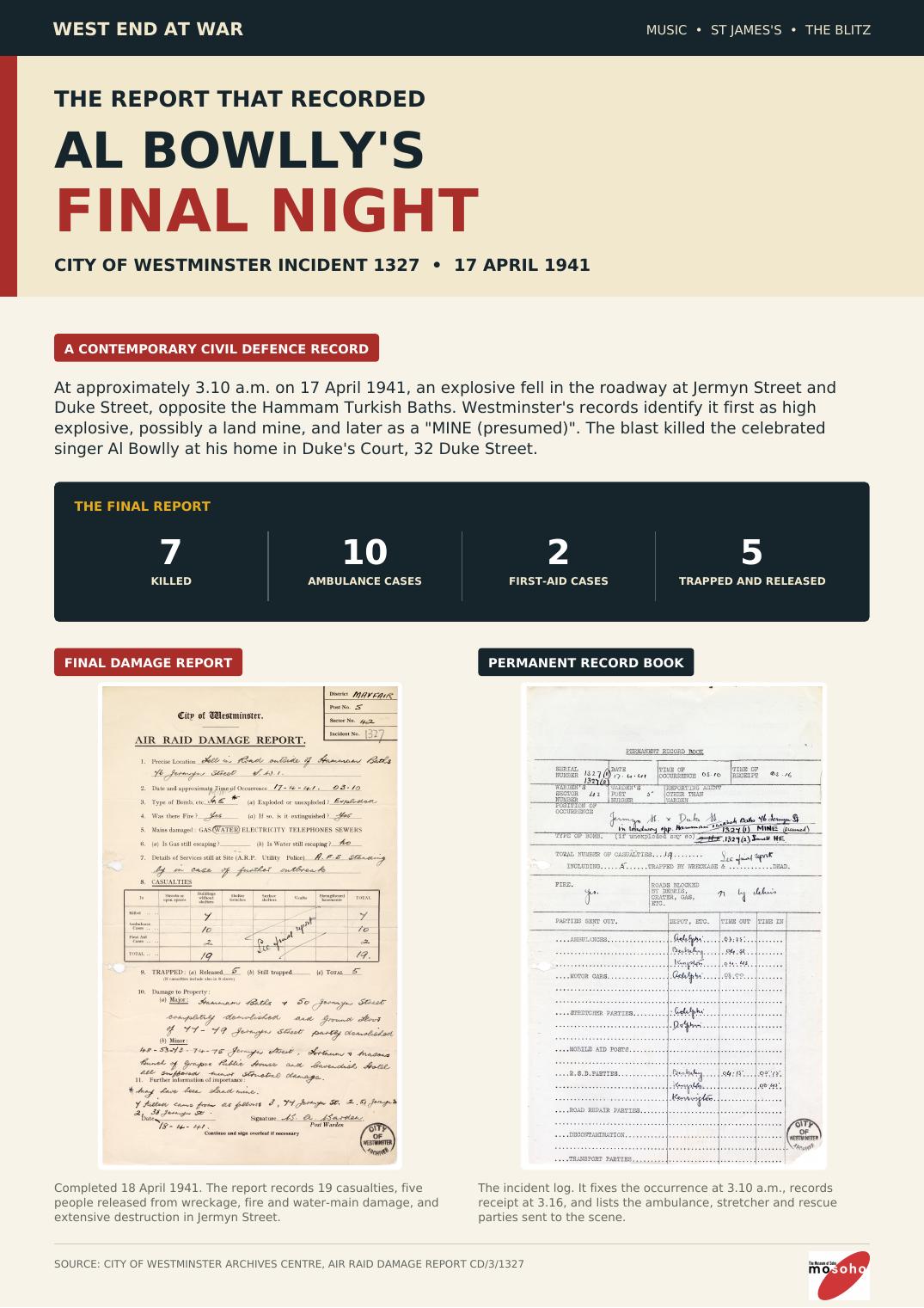
Westminster incident 1327 records an explosion at Jermyn Street and Duke Street at about 3.10 a.m. The blast killed singer Al Bowlly at his home in Duke’s Court, 32 Duke Street. The surviving damage report records seven deaths in the incident, ten ambulance cases, two first-aid cases and five people trapped and released.
MUSEUM OF SOHO ORAL HISTORIES
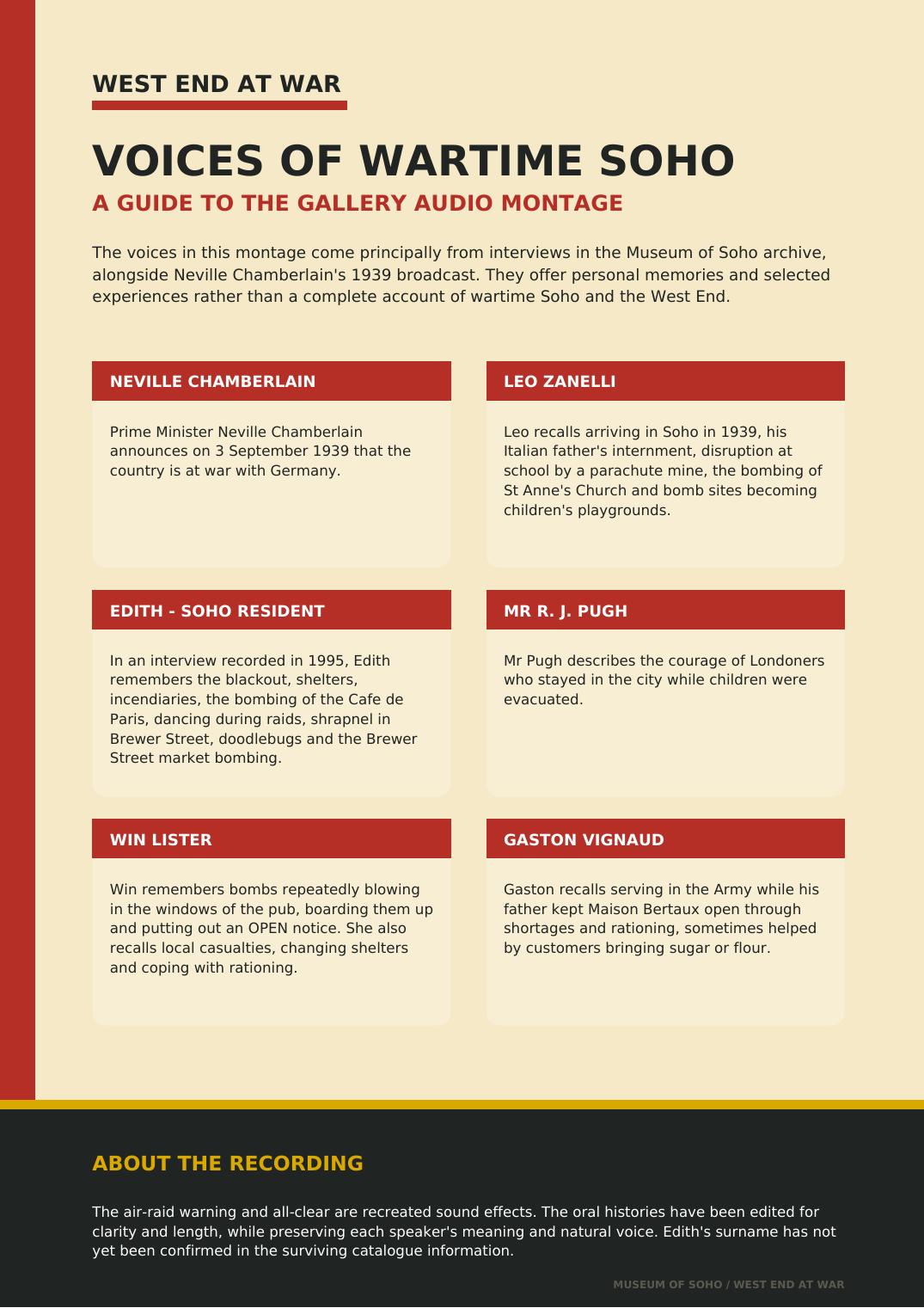
The 2026 exhibition brought the documentary record together with the Museum’s oral-history archive. Leo Zanelli recalled arriving in Soho in 1939, his Italian father’s internment, disruption at school by a parachute mine, the bombing of St Anne’s Church and bomb sites becoming children’s playgrounds. Edith remembered the blackout, shelters, incendiaries, Café de Paris, shrapnel in Brewer Street and the Brewer Street market bombing. Win Lister, Mr R. J. Pugh and Gaston Vignaud add further memories of raids, shelters, rationing and keeping Soho businesses open.
DIGITAL ARCHAEOLOGY
The original community website is no longer available in its complete form. The Museum of Soho is reconstructing the Soho material from surviving project files, archived URLs, contemporary references, Westminster material and associated collections.
Original files or complete surviving resources whose provenance can be established.
Material survives, but an original page, high-resolution asset, caption or associated document remains missing.
Contemporary evidence confirms that an item existed, but the original file has not yet been recovered.
This distinction allows the Museum to restore a lost public-history resource without blurring the line between original archive material and later reconstruction.
West End at War was originally developed by Westminster City Archives with volunteers and community participants, supported by a Heritage Lottery Fund project marking the 70th anniversary of the Blitz.
Digital reconstruction and Soho research: The Museum of Soho. Individual photographers, contributors, archives and rights-holders will be credited against each object wherever known.
Principal provenance used for this reconstruction includes Westminster City Archives / Westminster City Council, the surviving West End at War learning resources and film, contemporary Westminster Libraries material, The National Archives research guidance, and Museum of Soho research and oral-history holdings.