
Soho Stories · Gallery 1
St Anne’s Clock & Tower
From the Museum of Soho archive
The second-floor room houses the Parish Clock — a double three-legged gravity escapement installed by Gillett & Johnston in 1884. The clock cost £208 10s and was guaranteed to run within a limit of plus or minus two seconds a week.
It still runs within these limits. It was restored in 1979 by Soho clockmaker Michael McCoy to mark the Queen’s Silver Jubilee. The clock is wound three times a week by volunteers and strikes the hours from 7am until 11pm.
The original clock bell was cast by Mears and Stainbank of Whitechapel in 1691. Weighing about one ton, it was rehung in the new tower. This is the bell on which the Parish clock strikes to this day.
St Anne’s Church was consecrated by Henry Compton, Bishop of London, on 21 March 1686. The architects were either Sir Christopher Wren or William Talman, or possibly both. Building began in 1677 on this plot in Soho Fields, for a church of basilican plan about eighty feet long and sixty-four feet wide. The first important alteration was made in 1801–03, when the steeple was replaced by the one we see today. The architect was S. P. Cockerell.
The church was destroyed by bombing in September 1940; the tower, however, survived. The tower was derelict after the bombing, although it was used as a chapel for a while in the 1950s.
In 1979 it was partly restored by the Soho Society and in 1991, as part of the redevelopment of the whole church site, the tower was completely renovated at a cost of £150,000. The tower is a Grade II listed building.
The historic Museum page described Soho’s boundaries as Oxford Street to the north, Chinatown and Leicester Square to the south, Regent Street to the west and Charing Cross Road to the east.
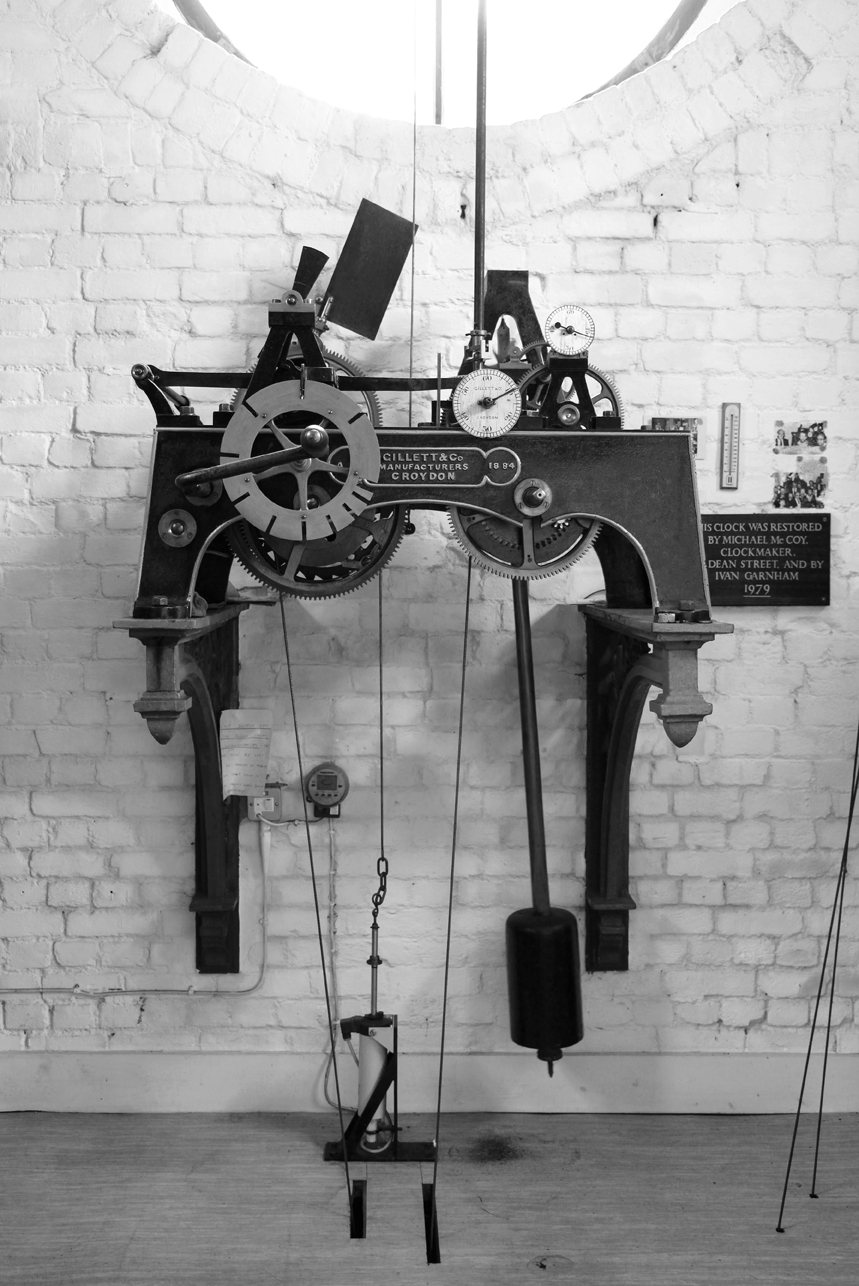
The St Anne’s parish clock mechanism by Gillett & Co., 1884